

|
Famous Haitians
Jacques Stephen Alexis Anacaona Jean-Bertrand Aristide Rose Anne Auguste Jean-Michel Basquiat Marleine Bastien Garcelle Beauvais Esther Boucicault Emmanuel "Manno" Charlemagne Marie Chauvet Coupé Cloué Edwidge Danticat Jean Dominique Jean-Jacques Dessalines François Duvalier Tyrone Edmond Hector Hyppolite Wyclef Jean Martha Jean-Claude
Emeline Michel Sweet Micky Félix Morisseau-Leroy Emile Ollivier Raoul Peck Charlemagne Peralte Gérard Pierre-Charles Yvonne Hakim Rimpel Jacques Roumain Manno Sanon Maurice A. Sixto Toussaint Louverture Loune Viaud Claudette Werleigh Poet, playwright - Born in Grand-Gossier in 1912 into a family of well-to-do mulattoes, he learnt both French and later English. Morisseau-Leroy studied at Columbia University in New York City. He went on to be a journalist in Paris, and director of the Public Education Office in Haiti, but he is famous for pioneering, and to an extent legitimizing, the use of the Creole language in Haitian literature and the performing arts. He believed that the use of Creole was the best tool for the education of the Haitain people. It was thanks in no small part to his efforts that Jean-Bertrand Aristide declared it an official language when he became president in 1991, at a ceremony where Morisseau-Leroy was one of the guests of honour.
His seminal work was the Creole language version of Sophocles' play, "Antigone", which was first performed in 1953 in Port-au-Prince. Up until then, writers and intellectuals had always used the French, and the staging of Antigone was the first time that Haitians could see a play performed in their own language. Outside of the theatre, he was a successful poet, and some of his best poems were contained in the volumes Diacoute (Port-au-Prince, 1953), followed by Diacoute II (Montréal, 1953) He fled Haiti in 1959, when it became clear the dictator, François Duvalier, considered his work to be subversive, but continued to write and publish poems in Creole from exile in Ghana, and Senegal. His works have also been translated into French, English, German, Russian, Fanti, Twi and Wolof. He finally established himself in Miami with his wife, Renée, and continued writing to the end. He died on 5 September 1998. His work gave generations of Haitians a sense of pride in their native language. Miami New Times feature article
Novelist - Born in Port-au-Prince on 19 February 1940, Ollivier was the only child of a lawyer and a homemaker with a great love of language. He left for a life of exile in Quebec in 1965. There he worked as a professor at the education faculty of the University of Montreal. He was a man of consequence, a deliberate thinker and writer. There are friends who took him to task for the long intervals between his books. But he couldn't help himself. He polished and chiseled away at his sinuous prose, publishing only when he has "worked a book through to its end." That perfectionism resulted in critical praise and awards: three of Ollivier's six works of fiction have been prize winners. Mère Solitude (Albin Michel, 1983; translated as Mother Solitude by David Lobdell) took the Prix Jacques-Roumain in 1985; La Discorde aux cent voix (Albin Michel, 1986) earned the literary prize of the Journal de Montréal in 1987; and the collection of short stories Passages (l'Hexagone, 1991) won the $10,000 Grand Prix Littéraire de Montréal in 1991. He also authored or co-edited works on literacy and immigration, the politics of development, and the ideology of "noirisme" in Haiti.He died in Montreal on 10 November 2002
Film maker - Grew up in Zaire where his parents had emigrated to escape the Duvalier dictatorship when he was eight years old. Graduated from the Berlin Film and Television Academy in 1988. Received international acclaim including best film at the 1994 Milan African Film Festival for L'Homme sur les Quais (1993), a moody and dark film set in a sleepy fictional Haitian town where the dictatorship of Francois Duvalier is viewed through the eyes of a young girl.
His other films include Haitian Corner (1987) about a man who, after seven years in a Haitian prison enduring physical and psychological torture, resettles in New York where he encounters his torturers on the streets of Brooklyn, and Corps Plongés (1997) also set in New York which explores a female pathologist's tangled relationships with two men; one, the exiled Haitian Minister of Health, the other, a married US politician. Peck was appointed Haiti's Minister of Culture in early 1996, but resigned in October 1997. Lumumba, a film about the life and murder of Congolese independence leader Patrice Lumumba, won the Paul Robeson prize for the best film by a director of African descent outside the continent at the 17th Pan-African Cinema and Television Film Festival in February 2001. Peck is the founder of the Fondation Forum Eldorado, dedicated to cultural development in Haiti and the Caribbean and working with schools and underprivileged communities in Haiti. For the work of the Fondation, Peck bought a movie theatre called the Eldorado near the Oloffson Hotel in Port-au-Prince. With the help of contributions, the theatre has become one of the rare local facilities affordable to local artists and schools. Raoul Peck lives and works in Voorhees, New Jersey, in Paris, France, and in the tiny town of Port-a-Piment, south-west Haiti. Interview with Raoul PeckBack to list
Guerrilla leader - Born in 1886 in Hinche, Péralte was an officer in the Haitian Army. He resigned in 1915 and returned to his home in Hinche to become a farmer. When the US Marines, who had invaded Haiti in 1915, began forcing Haitians into labour gangs to carry out public works, antipathy to the US occupation grew. In 1917 Péralte was arrested for an attack on the home of a US officer, and sentenced to five years hard labour. He escaped from captivity, and mobilised several thousand peasant irregulars to fight against the US occupation. The success of the guerrilla resistance campaign led by Péralte, forced the US to deploy more Marines, but he was still able to declare a provisional government in the north of Haiti in 1919.
In November 1919 Péralte was betrayed by a spy, and killed by a US Marine. A famous photograph, picturing the dead leader tied upright to a door, Christ-like, has taken its place as an icon of Haitian nationalism. Back to list
Politician - One of Haiti's best known political scientists, Gérard Pierre-Charles was born in Jacmel in 1935. For many of his 26 years living in exile in Mexico during the Duvalier dictatorship, Pierre-Charles taught at the Autonomous National University of Mexico, specialising in the study of the economic, political and social development of the Caribbean region. Author, or co-author, of over 30 books, two of them in particular made a significant contribution to the analysis and understanding of François Duvalier's Haiti - L'Economie Haitienne et sa Voie de Développement (The Haitian economy and its development path) (1965) and Radiographie d'une Dictature (X-ray of a dictatorship) (1969).On returning to Haiti in 1986, together with his wife, Suzy Castor, Pierre-Charles founded the non-governmental organisation, Centre de Recherche et de Formation Economique et Sociale pour le Développement (CRESFED). A leading figure in the Lavalas Political Organisation (OPL) that won the majority of seats in the 1995 elections, Pierre-Charles played an increasingly prominent role in national politics when the OPL split with Jean-Bertrand Aristide and other former allies in 1996. While Aristide formed the Lavalas Family Party, the OPL changed its name to the Organisation of People in Struggle. Following the 2000 elections, the OPL joined other anti-Lavalas Family parties in forming the Democratic Convergence coalition, and Pierre-Charles participated in the interminable negotiations with the OAS in search of a solution to the political stalemate. In January 2003, Pierre-Charles was awarded the highest honour the Mexican government can bestow on foreign dignitaries. Mexico's Foreign Relations Secretary, Jorge Castaneda, said Pierre-Charles' work at Mexico's largest university had "provided an extraordinary contribution" to Caribbean studies in Mexico. Gérard Pierre-Charles died on 10 October 2004. Obituary
Feminist, journalist - Born in Port-au-Prince in 1906, Rimpel was a founder of the first Haitian feminist organisation, the Women’s League for Social Action (Ligue Feminine d’Action Sociale). It was founded in 1934 by a group of women intellectuals, professionals and activists from the middle and upper classes, and played an important role in politics for the next 25 years, focusing mainly on legal rights - suffrage, access to education, equality for married women. In 1951, she founded Escale, a bi-weekly news revue, and for six years she was its director, driving force, and main editor.The Constitution of 1950 gave women a limited right to vote (with their husbands’ permission) but it was not until 1957 that they obtained full equal suffrage. Rimpel, a supporter of presidential candidate, Louis Déjoie, was an active participant in the electoral campaign. When François Duvalier emerged as winner, she criticised the role of General Kébreau in assuring Duvalier's victory. On the night of 5th January 1958, François Duvalier sent a group of masked men to Rimpel's house. They dragged her off into the night, and the next morning she was found lying naked in a street in Petionville, beaten unconscious, covered in blood, and probably raped. After two months in hospital, she recovered, but she never wrote again. She maintained her silence until her death in June 1986. Challenging Violence: Haitian Women Unite Women’s Rights and Human Rights by Anne FullerBack to list
Writer, political activist - Born in 1907, he was educated in Belgium and Switzerland but returned home in 1927 to fight for Haitian nationalism. As president of the Haitian Patriotic Youth League, Roumain was instrumental in organising the agitation that brought an end to the US occupation of Haiti (1915-34). He was arrested in December 1928, released in August 1929, and arrested again in October, 1929, but despite this he was a productive writer, publishing several collections of stories and poetry. He started the magazine, La Revue Indigene, and published the book, La Montagne Ensorcelée (1931). In 1934, he founded the Haitian Communist Party but was soon arrested and, after three years in prison, he was exiled. In his travels in Europe and the US, Roumain forged close friendships with other writers, notably Langston Hughes, who translated some of his poetry. With the change in government in Haiti, Roumain was allowed to return to Haiti, and 1941 he established the Bureau d'Ethnologie in an effort to legitimise the study of Haiti's peasantry. In 1943, President Lescot appointed him chargé d'affaires in Mexico, where he completed two of his most influential books, the poetry collection Bois d'ébène (Ebony Wood) and the novel, Gouverneurs de la Rosée (Masters of the Dew). When he died in August 1944, at the age of 37, Roumain was one of the most prominent pan-African poets, acclaimed in Europe and Latin America. Back to list
Footballer - Born into a poor Port-au-Prince family in 1951, Sanon made his name as a striker with the Don Bosco club of Petionville. In 1973 the Haitian Football Federation, with the backing of the dictator Jean-Claude Duvalier, successfully lobbied for the CONCACAF World Cup qualifying tournament to be staged in Port-au-Prince. The favourites, Mexico and Trinidad, were eclipsed by the young Haitian team, and Sanon's goals propelled his team to the top of the group. Haiti became the first Caribbean team to qualify for the World Cup Finals.
The 1974 World Cup Finals in West Germany were contested by just 16 teams. Haiti's first game, against the 1970 runners up, Italy, took place in Munich in front of 65,000 spectators. 0-0 at half time, but within two minutes of the restart, Sanon claimed his place in World Cup history, and in the hearts of Haitian fans, by giving Haiti the lead against the legendary Italian goalkeeper, Dino Zoff. Hugh McIlvanney, of The Observer newspaper wrote "Emmanuel Sanon, a powerfully built and spiritedly aggressive forward from Port-au-Prince, did what some of the greatest players in the world had failed to do in Zoff's 12 previous games for Italy." The Haitian team lost the game, and their two others against Poland and Argentina, but Sanon had become a star. In four years he scored 47 of the 106 goals scored by the Haitian national team, and he went on to enjoy a successful career with Beershcoot of Antwerp, at that time a force in Belgian football. He has recently returned to live in Haiti, and is currently a trainer of the Haitian national team. Back to list
Humourist and raconteur - Born in Gonaives on 23 May 1919, Sixto attended the prestigious Saint-Louis de Gonzague high school in Port-au-Prince. He then joined the Police Academy (Académie Militaire) but dropped out after just three months and later became journalist. He worked for the daily paper Le Matin and the MBC (HHBM at the time) radio station. To make ends meet, he also worked part time as a guide for the Department of Tourism. In 1961, he left Haiti for the Republic of Congo - Kinshasa (later Zaire, and now Congo) where he taught English. In 1969, he left Zaire for Paris, and later settled with his wife in Philadelphia, USA, where he died in 1984.
Sixto brought to life the many faces of the Haitian aristocracy through his recordings such as "Léa Kokoyé" (1975), "Ti Sainte Anize" (1978), "Maitre Zabelboc Berre-à-chatte" (1979), "Gwo Mosso" (1984), and "Madan Saint Viluce" (1985). Over the years, the story of Ti Sainte Anize, a fictional 'restavek' girl who lives in the house of a professor greatly concerned with human rights but oblivious to the injustice beneath his nose, has become a classic, constantly requested on Haitian radio stations. Restavek is the Haitian word for child servants who are sent to live with better-off families in the hope of finding a better life and an education but more often than not suffer a life of drudgery and abuse. Ti Sainte Anize, who must look after "Mademoiselle," the professor's daughter, Chantale, is constantly chastised by the professor's shrewish wife who calls the child a liar, and a thief. "Sainte Anize," says the wife, "come, take Mademoiselle's book bag. Do I have to tell you every day? You'll make her late for school. Oh, my. This book bag is filthy. Why don't you clean it with your tongue, if you can't find a rag?" It wasn't the first time a Haitian artist had mentioned the abusive treatment of restaveks. But Sixto's satire hit home, particularly among the many educated Haitians who had lived, like Sixto, in exile abroad. In 1990, the Swiss organisation, Terre des Hommes, set up the Foyer Maurice Sixto, a home for restavek children named after the famous raconteur. The home in Port-au-Prince is run by the Haitian priest, Père Miguel Jean-Baptiste. Back to list
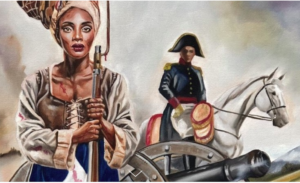
Leader of the Haitian Revolution - Born in 1743, the eldest of eight children born to slaves on the Bréda plantation in northern Haiti. Taught to read and write by his godfather, Toussaint rose quickly in rank among the household slaves, and became first his master's coachman, and then steward of all livestock on the estate. In the early months of 1792 he joined the slave uprising and began to organise the rebellious slaves into a revolutionary army.
A skilful military leader, expert at guerrilla warfare, and able to instill loyalty, respect and admiration in his followers, he soon became the undisputed leader of the black forces. Over the years of bloody conflict, he maneouvered and manipulated the competing armies of French Republicans and Royalists, the Spanish and British, to achieve the goal of an independent republic free from slavery. Toussaint himself was captured by the French in 1802 and was taken to France. He died in prison in April 1803, but as, William Wordsworth wrote in his poem, To Toussaint L'Ouverture, "Though fallen thyself, never to ride again, Live and take comfort. Thou has left behind Powers that will work for thee." Under the command of Jean-Jacques Dessalines, the united black and mulatto forces defeated the troops sent by Napoleon Bonaparte to reimpose slavery, and the revolution was completed when Haiti declared independence on January 1st 1804. Recommended reading -The Black Jacobins - CLR James Back to list
Health worker - Born in the coastal town of Port-Salut in the south of Haiti, Loune Viaud is a feminist determined to help women in poverty. She pioneered central Haiti’s first women’s health centre - she helped inaugurate Proje Sante Fanm in December 1990 - and has since helped train scores of women’s health agents and traditional birth attendants. In addition, she has implemented several women’s literacy projects, a scholarship program for girls and a gender-awareness curriculum for training health care personnel.Today Viaud is the director of strategic planning and operations at Zanmi Lasante, a huge socio-medical complex in Cange, Haiti, which offers free health care to hundreds of thousands of people. Under Viaud’s direction, the Cambridge-based Partners in Health programme received international attention for its success in providing treatment to several hundred AIDS patients in a poor, isolated setting, a feat that could have global implications for fighting AIDS. Viaud’s expertise in helping draft Haiti’s and Zanmi Lasante’s proposal to the Global Fund for AIDS, Tuberculosis and Malaria resulted in a $67 million grant to Haiti and Zanmi Lasante, which means she will be directing the world’s largest AIDS treatment program. Viaud has been honored by many poor communities in Haiti over the years. She also received a Peace and Justice Award from the Cambridge Peace Commission in 2000, and was selected as the 2002 Robert F. Kennedy Human Rights Laureate.
More on Loune Viaud
Politician, development and peace campaigner - Born in Cap-Haïtien in 1946, to a well-to-do family, Werleigh trained and studied medicine in the United States and Switzerland, before returning to Haiti to take a degree course in law and economics at the State University in Port-au-Prince. She then worked for a number of non-governmental organisations in the fields of adult literacy and humanitarian relief. From 1976-1987, she was secretary-general of Caritas Haiti, an organisation created in 1975 by the Haitian Bishops' Conference to take practical steps to support the construction of a more just and equal society. During these years, the Catholic Church was instrumental in the development and growth of the anti-Duvalier and pro-democracy movement in Haiti. In the post-Duvalier period, Werleigh helped found the League for Women's Empowerment (Lig Pouvwa Fanm), an organisation promoting the participation of women in politics. Describing her work to bridge the gulf separating different worlds - the poor and the affluent, women and power structures, Werleigh said, "I never had to worry about money, but very young I realised that unless there were changes in the system, people like my family would always have money while others, like the peasants that were selling us their coffee and buying our goods, would always be in a poorer condition."From 1990 onwards, Werleigh became active in public administration and politics in Haiti, serving as Minister of Social Affairs from March-August 1990 during the interim Trouillot adminstration and then as chef de cabinet in Prime Minister René Préval's office, from March - September 1991. Following the military coup that overthrew the Aristide/Préval government, she went into exile. From July 1992 - October 1993, she was the executive director of the Washington Office on Haiti, an advocacy and lobbying organisation. In September 1993, she was appointed Minister of Foreign Affairs in the Malval government-in-exile. She retained this post when the constitutional government was restored in October 1994. In November 1995, Werleigh was appointed Prime Minister - the first woman to hold the post in Haiti - in the post-return government of President Aristide. From 1999-2006, Werleigh was the Conflict Transformation Programmes Director of the Life and Peace Institute in Uppsala, Sweden, leading field activities aimed at facilitating and strengthening local peace-building initiatives in war-torn societies such as in the Horn of Africa, Democratic Republic of Congo, and Congo Brazzaville. In November 2007, she was elected secretary-general of Pax Christi International, a non-governmental Catholic peace movement working on a global scale on a wide variety of issues in the fields of human rights, security and disarmament, economic justice and ecology.
1998 interview with Claudette Werleigh |